
"Crypto payments are basically free, right?" — every PM I've ever met.
Crypto rails are dramatically cheaper than card networks for the right size of transaction. But there are five places fees show up, and most "Stripe vs crypto" comparisons quietly leave four of them out. Here's the honest, all-in breakdown so you can model your real take-rate.
TL;DR#
For a typical $25 stablecoin payment on a low-cost chain (USDC.solana, USDC.polygon, USDT.tron), the merchant's all-in cost is roughly 0.7%–1.2% vs roughly 2.9% + $0.30 for a US-issued card on Stripe. The crossover point where crypto becomes cheaper than cards is around $2 per transaction.
Below that, gas as a percentage of the order eats your margin. Above it, crypto wins by a wide margin.
The five fees that actually exist#
1. Network gas (paid by the customer)#
This is the on-chain fee for the transfer from the customer's wallet to the per-intent deposit address. The customer pays it; you don't. It does, however, affect whether they pay at all — a $5 gas fee on a $20 order is a conversion killer.
| Chain | Stablecoin transfer cost (median, 2026) |
|---|---|
| Tron | $0–$1 (free if sender has energy) |
| Solana | <$0.001 |
| Polygon | <$0.01 |
| BNB | <$0.10 |
| Ethereum | $0.50–$5 |
Practical rule: don't accept Ethereum mainnet for orders below $50.
2. Gateway fee (paid by the merchant)#
This is the only fee that maps cleanly to a card processor's "% + fixed" model. It's how the gateway pays for nodes, custody, dashboard, support and the engineering team.
BchainPay charges 0.7% per successful payment, no fixed fee, no monthly minimum. Fail-to-pay events are free.
3. Sweep gas (paid by the merchant, hidden if you're not careful)#
When the gateway moves funds out of per-intent deposit addresses into the merchant pocket, that costs gas. On Ethereum, sweeping a 65k-gas USDC transfer can cost more than the gateway fee on a small payment.
We bundle sweep gas into the 0.7% fee on EVM chains and absorb it. Cheaper chains (Solana, Tron) effectively cost us nothing here, which is why you'll often see crypto gateways quote different rates per chain. We don't, because the cross-subsidy is small enough at our volume to keep one number.
4. Withdrawal gas (paid by the merchant)#
When you withdraw from your pocket to an external address you control, that transfer also costs gas. We pass it through at cost — no markup.
For a USDC.polygon withdrawal: < $0.01. For a USDC.ethereum withdrawal: $0.50–$5 depending on time of day. For a USDT.tron withdrawal: free if the destination has energy.
If you withdraw daily, that's a meaningful line item on Ethereum. If you withdraw weekly, it's noise.
5. FX (paid by the merchant, optional)#
Optional because you can choose to keep stablecoin pockets and pay suppliers / payroll in stables — many of our merchants do exactly that. If you off-ramp to fiat, your bank or off-ramp provider will charge an FX spread (typically 25–80bps) plus a wire fee.
A reasonable assumption for a US merchant off-ramping USDC to USD via a tier-1 provider: 0.3% spread + $0 wire fee on ACH, or +$25 on international wire.
A worked example: $25 SaaS subscription#
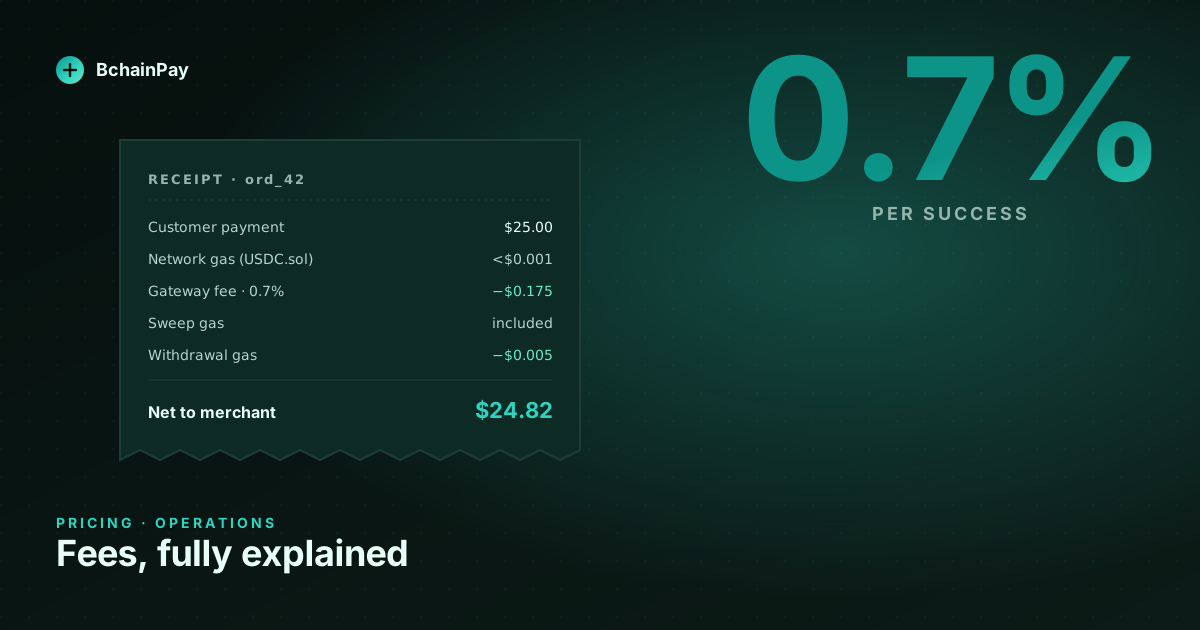
| Line item | Amount | Who pays |
|---|---|---|
| Customer payment | $25.00 | — |
| Network gas (USDC.sol) | <$0.001 | Customer |
| Gateway fee 0.7% | $0.175 | Merchant |
| Sweep gas | included | (in 0.7%) |
| Withdrawal gas | $0.005 | Merchant |
| Net to merchant | $24.82 | (99.3%) |
Same payment on Stripe (US card, US merchant): $25.00 - 2.9% - $0.30 = $23.97 (95.9%).
For 1,000 such payments per month, the difference is $25 × 1000 × (99.3% - 95.9%) = $850 extra revenue, every month, with no operational change for you.
Where crypto loses#
Honest disclosure — crypto is worse than cards for:
- Sub-$2 transactions on any non-Solana chain. Even at near-zero gas, the gateway fee floor matters. Stripe's $0.30 fixed beats us for micro-transactions.
- Customers who insist on credit-card chargebacks. That's not a feature of crypto rails, period. If your category has a 5%+ dispute rate, you should be on cards (or have a dispute-resolution layer of your own).
- Currencies you actively want to take FX risk in. If your customers want to pay in EUR and you want to keep EUR, USDC isn't the right rail — you want SEPA Instant.
How to estimate your own take-rate#
A quick worksheet:
Median order value:           $___
Chain mix (% per chain):      ___
Withdrawal frequency:         daily / weekly / monthly
Off-ramp to fiat?             yes / no  (if yes, +0.3%)

Effective fee % ≈
    0.7%                                              (gateway)
  + (sweep gas only on Ethereum, ≈ 0.2% if median <$50)
  + (withdrawal gas) / (median order × payments per withdrawal)
  + (0.3% if off-ramping)
For most merchants on a stable-friendly chain mix and weekly off-ramps, the answer lands between 0.7% and 1.2%.
What this means for pricing your product#
Two practical implications:
- Crypto rails make low-AOV businesses viable. A $5 SaaS plan or a $3 unlock IAP is unprofitable on cards once chargebacks and floor fees enter the model. On Solana stables it's healthy.
- Crypto rails change "international" from a tax to a freebie. No 1.5% cross-border fee, no FX surprise. A merchant in Lagos and one in Lisbon pay you the same way at the same price.
If you'd like to model your specific case, the BchainPay calculator will give you a quote in 30 seconds. Or just email me — happy to help you spread- sheet it.