
A shopper pays 200 USDC on Base. The merchant settles to USDC on
Arbitrum, because that's where their treasury, their accountant and
their off-ramp live. Somewhere between the checkout tx and the
merchant's balance dashboard, those 200 USDC have to cross a chain
boundary. There is no native messaging primitive between EVM L2s; you
need a bridge.
For stablecoin-denominated merchant settlement specifically, two options dominate the conversation in 2026: Circle's Cross-Chain Transfer Protocol (CCTP) and LayerZero v2 (typically via the OFT standard or Stargate). They look superficially similar — "send USDC from chain A, receive USDC on chain B" — and they are radically different in their trust model, cost shape and operational behavior.
This post is the comparison we did internally before picking a default. It is not a marketing post for either side. It's the one I wish someone had written before I had to read both whitepapers and three audits.
The two architectures in one paragraph each#
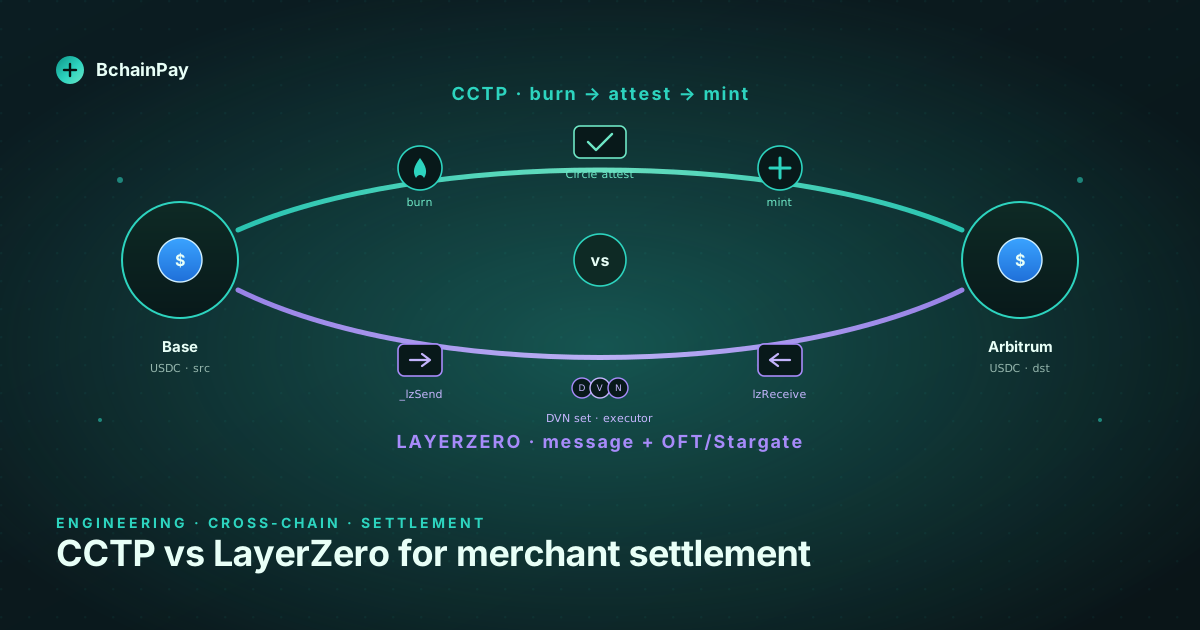
CCTP is burn-and-mint. The source-chain TokenMessenger contract
burns native USDC and emits a MessageSent event. Circle's
off-chain attestation service watches that event, signs an
attestation, and exposes it via REST. Anyone can take that
attestation and call receiveMessage on the destination
MessageTransmitter, which mints the equivalent native USDC.
There is no liquidity pool, no wrapped token, and no third-party
validator set. Trust is concentrated in Circle.
LayerZero v2 is generic message passing. A OApp (or OFT for
tokens) on the source chain calls _lzSend, which is picked up by a
Decentralized Verifier Network (DVN) — actually a configurable
set of verifiers, defaulting to LayerZero Labs + one partner — that
attests to the message hash on the destination, where an executor
delivers it. For tokens, this is typically a lock-and-mint of an OFT,
or a pool-based swap via Stargate. Trust is split across the chosen
DVN set; the user/app picks the security model.
The mental model that matters: CCTP moves the canonical asset by destroying and recreating it. LayerZero moves a message that represents an asset (or instructs a pool).
What you actually pay#
For a single 200 USDC settlement from Base to Arbitrum, here is the breakdown we measured on production traffic in March 2026. Numbers are USD-equivalent; gas prices are typical, not best-case.
| Cost component | CCTP v2 (Fast) | LayerZero (Stargate) |
|---|---|---|
| Source gas (burn) | $0.018 | $0.024 |
| Attestation fee | $0.00 | $0.0006 (DVN) |
| Destination gas (mint/credit) | $0.041 | $0.052 |
| Protocol/pool fee | $0.00 | $0.10 (5 bps) |
| Total | $0.059 | $0.177 |
CCTP wins on raw cost for any USDC-only flow because there is no pool fee and no validator economic incentive to fund. LayerZero's pool fee scales with notional; for a $50,000 settlement, Stargate's 5 bps becomes $25, while CCTP stays roughly fixed. We have not seen a single notional size at which Stargate beats CCTP for native USDC.
That said, LayerZero is the only option for non-USDC tokens or
for packaging additional logic with the transfer. If you want to
settle USDC and atomically credit the merchant in a destination
contract in the same message, CCTP v2 supports depositForBurnWithHook
now — closing what used to be a real gap. Pre-v2, this was
LayerZero's main wedge.
Speed and finality#
This is where the comparison actually gets interesting, because "how fast does the money arrive" is the question merchants ask.
- CCTP v1 waits for source-chain hard finality before Circle attests. On Ethereum L1 that's ~13 minutes. From Base to Arbitrum it's typically 8–15 minutes — long enough that no checkout flow can present "settled to your treasury chain" inside the user session.
- CCTP v2 Fast Transfer introduces a Circle-bonded fast lane that attests against soft finality and assumes the reorg risk itself, charging a small Fast fee. On L2-to-L2, this routinely lands in under 30 seconds. Standard transfer remains available for cost- sensitive flows that can wait.
- LayerZero finality is whatever the DVN set requires. The default configuration on most L2s waits for source-chain commitment to L1 before the DVN signs, which puts you in the same 8–20 minute window as classic CCTP. You can configure a faster DVN set (or pre-crime + faster confirmations) but you are taking on the reorg risk yourself, with no protocol-level bond.
For checkout settlement, the practical answer in 2026 is: CCTP v2 Fast for USDC, LayerZero for everything else, and never present a "settled" UI to the merchant until the destination tx is mined.
Trust assumptions#
This is the part most comparison posts skip, and it matters more than fees.
CCTP trusts Circle. If Circle's attestation service is offline, no transfers complete. If Circle's signer key is compromised, an attacker can mint USDC on any supported destination chain. There is no cryptographic recovery path other than Circle revoking the key and the destination contracts honoring the revocation. The blast radius is bounded by Circle's USDC reserves, but the failure mode is "trust one company".
LayerZero v2 trusts the DVN configuration you chose. The default ("LayerZero Labs + Polyhedra") trusts two parties; you can require N-of-M with independent DVNs (Google Cloud, Nethermind, etc.) at the cost of slightly higher per-message fees. There is also a configurable "block confirmations" threshold and an optional pre-crime simulation. The failure mode is "trust this specific set of verifiers I configured".
Neither is "trustless". Both have a single-point-of-failure shape if configured naively. The honest framing:
- For native USDC, CCTP's trust assumption is the same trust assumption you already accept by holding USDC at all. You are already trusting Circle's reserves and freeze powers. CCTP doesn't add a new trust party.
- For everything else, LayerZero lets you choose and change the verifier set per message, which is genuinely useful but requires you to actually think about the configuration. The default is fine for low-value flows; high-value treasury moves should override it.
The integration shape#
What it looks like to integrate each into a payment gateway. We use TypeScript snippets that mirror what you'd write against viem.
CCTP v2 burn#
import { parseUnits, encodeAbiParameters } from "viem";

const amount = parseUnits("200", 6);

const burnTx = await tokenMessenger.write.depositForBurn([
  amount,
  destinationDomain,            // 3 = Arbitrum
  pad(merchantTreasury, 32),    // mint recipient
  USDC_BASE,                    // burn token
  pad("0x00", 32),              // destinationCaller (any)
  parseUnits("0.05", 6),        // maxFee for Fast (USDC)
  1000,                         // minFinalityThreshold (Fast)
]);

const receipt = await publicClient.waitForTransactionReceipt({ hash: burnTx });
const messageBytes = parseLog(receipt, "MessageSent").args.message;
const messageHash  = keccak256(messageBytes);
Then poll Circle's attestation API:
const { attestation } = await fetch(
  `https://iris-api.circle.com/v2/messages/${messageHash}`
).then(r => r.json());

await messageTransmitter.write.receiveMessage([messageBytes, attestation]);
Total integration: two contract calls and one HTTP poll. That's it.
Webhook your sweeper when MintAndWithdraw fires on the destination
and credit the merchant.
LayerZero OFT send#
const sendParam = {
  dstEid: 30110,                          // Arbitrum endpoint id
  to: pad(merchantTreasury, 32),
  amountLD: parseUnits("200", 6),
  minAmountLD: parseUnits("199.5", 6),    // slippage on pool route
  extraOptions: Options.newOptions().addExecutorLzReceiveOption(200_000n, 0n).toHex(),
  composeMsg: "0x",
  oftCmd: "0x",
};

const { nativeFee, lzTokenFee } = await oft.read.quoteSend([sendParam, false]);

await oft.write.send([sendParam, { nativeFee, lzTokenFee }, refundAddress], {
  value: nativeFee,
});
Conceptually heavier: you're paying for a generic message, you're
quoting the cost up-front, and you're picking executor options. In
return, you can attach a composeMsg to invoke any contract on the
destination atomically with the credit — useful for "settle and
auto-swap to USDT" or "settle and pay 5 sub-merchants" without a
second cross-chain hop.
When to pick which#
After roughly nine months of running both in production for merchant settlement, this is our default routing logic:
function pickBridge(req: SettlementRequest): "CCTP_V2_FAST" | "CCTP_V2_STANDARD" | "LZ_OFT" | "LZ_STARGATE" {
  if (req.token === "USDC" && req.fastSettlement) return "CCTP_V2_FAST";
  if (req.token === "USDC")                       return "CCTP_V2_STANDARD";
  if (req.token === "USDT" && req.route.dstChain === "Tron") return "LZ_STARGATE";
  if (req.requiresAtomicComposeOnDst)             return "LZ_OFT";
  return "LZ_STARGATE";
}
In plain English:
- USDC settlement → CCTP v2. Lower cost, no pool slippage, no net new trust party. Use Fast for checkout-driven settlement, Standard for scheduled treasury sweeps where 15 minutes is fine.
- Settlement that needs to do something on arrival (atomic swap,
fan-out, contract call) → LayerZero OFT with
composeMsg. CCTP's hooks are improving but not yet at parity. - Non-USDC stablecoins or chains CCTP doesn't support (Tron USDT, most non-EVM chains beyond Solana, several appchains) → LayerZero, usually via Stargate's pools.
- High-value treasury moves of any token → LayerZero with a custom DVN set (3-of-5 with at least one non-default verifier), with pre-crime enabled and a 96-block source confirmation requirement. Slower, more expensive, materially harder to attack.
The ratio in our production traffic ends up roughly 78% CCTP, 22% LayerZero, weighted by message count. By notional value, LayerZero is higher because the high-value treasury moves go through it.
What we got wrong#
A few things we had to learn after shipping:
- CCTP attestation polling is not free. At one message per second per merchant we hit Circle's rate limits. The fix was webhooks-on-mint at the destination chain rather than polling.
- LayerZero's default DVN was insufficient for treasury sweeps. We moved high-value flows to a 3-of-5 set after a partner DVN had a 40-minute outage. The ~3x fee increase was worth it.
- "Cross-chain" as a merchant-facing concept is poison. The right UX is a single "settle to chain X" toggle, with the gateway picking the route. Exposing CCTP vs LayerZero to merchants generated support tickets and zero value.
- Refund flows are asymmetric. Plan refund logic with the assumption that cross-chain settlement is one-way and absorb the asymmetry at the application layer.
Key takeaways#
- CCTP burn-and-mint is the cheapest, simplest path for native USDC settlement and adds no new trust party beyond Circle itself.
- LayerZero v2 is the right tool for non-USDC tokens, atomic compose on the destination, and cases where you want to choose your own verifier set.
- CCTP v2 Fast Transfer collapses cross-chain settlement latency to seconds for USDC; pre-v2 timing assumptions are now stale.
- Trust is configurable on LayerZero and fixed on CCTP. Use a hardened DVN set for high-value treasury moves; default DVN is fine for low-value flows.
- Don't expose the choice of bridge to merchants. Route at the gateway, present settlement chain as the only knob.
- Plan for one-way settlement: refunds and reversals do not work symmetrically across either protocol, so design payment intents to absorb that asymmetry at the application layer.